


Big Walk Is A Communal Experience With Big Heart
I think I've just found my new all-time favorite co-op game.

When House House revealed Big Walk, a game about walking and talking, I will admit: I found the concept charming, but I was a little skeptical of how it would feel to play. Over the last few years, we've had a wave of multiplayer, proximity-chat based games release, many of which I've enjoyed in small bursts, but generally, personally, find a bit overwhelming and overstimulating to play, especially for more than a few sessions or for short bursts of time. I was really curious: what would this team -- who made the incredibly delightful Untitled Goose Game -- do with this concept of proximity-based, co-op gaming?
Panic
Hang out and get lost with close friends in a big world. A cooperative online walker-talker from the creators of Untitled Goose Game.
On paper, Big Walk holds similarities to other popular multiplayer titles that've been — whether fondly, ironically, or otherwise — deemed "friendslop". To be clear, while I don't really like the term, it's used widely enough that I'm using it here as a general descriptor for a type of lower cost, quick dev cycle, multiplayer, proximity chat based game that relies heavily on social interaction and players for the fun and replayability.
After playing Big Walk, while I see the similarities, I don't think it really fits in that same bucket (or, at least, is expanding what we could potentially mean with this phrase). To be clear: this is absolutely not a knock on any of those other titles or the category as a whole...I just think Big Walk has a different tone and design sensibility that focuses on more curated, specific scenarios and a gentler pace that the developers have set up to help illicit those memories and fun interactions with friends, and it just so happens to also be multiplayer and use proximity chat.
Because of it's pacing, goals, and design, I do think it has the potential to feel more approachable to a broader audience through the ways it utilizes so many of those familiar "friendslop" elements in addition to open world exploration, an appreciation for the natural world, and overall slower pace in incredibly approachable and refreshing ways. It's also not created as procedural or eternally expanding experience, at least not in terms of content: this is a game with an ending. It's all of this, combined with the fun I had while playing, which make me feel like this may be one of the most joyful, sincere, and earnest games about building community and friendship I've ever played.
Before going further, thank you to popagenda for providing me with a review key to be able to play and prepare my thoughts ahead of the game's launch.
Watch this article in video form on YouTube if you'd like to see clips of the game in-action!
How Much Have I Played?
I've been primarily playing with my fellow co-hosts at The Indie Council (yay Janet and Jill!), and while we're not done yet, we have invested about 11 hours into the game as of this post.
For context, we've been told to anticipate the game taking between 12 and 20 hours to complete for most folks, depending on your style of play. I will say, while we're pretty free-spirited in the ways we've been exploring, I do think we've made pretty significant progress, and I think could beat the game in one more hefty play session. And, while I haven't finished the game — and there are some questions I have about the potential ending — I can confidently say that this has been one of my favorite games we've gotten to play together, and one of my favorite co-op experiences (perhaps of all time).
What is Big Walk?
The developers have called Big Walk a "cooperative multiplayer adventure about teamwork and talking" and, frankly, that does sum it up pretty well. It's releasing August 4th for Nintendo Switch 2, Steam (PC and Mac), and PlayStation 5, and it does support cross-platform play!
You DO have to play it with at least one other person, but you can invite up to 11 other folks to join in the fun for a total of twelve people hanging out and exploring together. Puzzles scale based on how many folks are joined up for the session, but they only scale up to four people, so don't anticipate them getting overly complex.
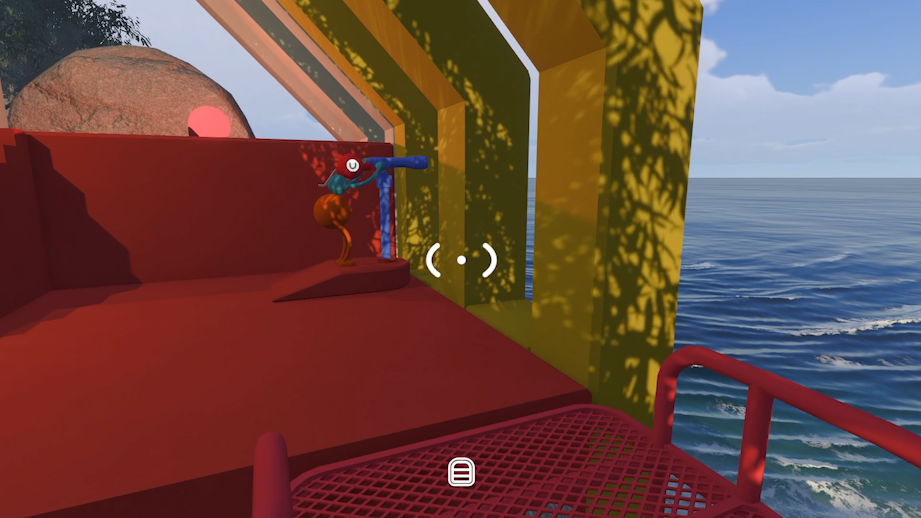
What's in the distance? Another puzzle, perhaps!
One player will be the designated host: they are responsible for the save file, and to complete the game, you'll want to join up with the same host each time. Everyone does not get their own save instance! But, joining a game is incredibly easy -- the host simply shares the join code generated and you're instantly all brought into the same hub area. You can also switch how many people are playing each session: we started with three, for example, and in a different session, switched to playing with four people, no problem. Playing again later, we were able to hop back down to three. It's flexible and convenient, and I LOVE that the devs designed this with daily life in mind: it is HARD to get the same people together all the time!
The game is in first-person perspective, which I don't often play in because I do get a little disoriented with some games, but I didn't personally experience any of that while playing this one. You can use controller or keyboard, and your main movements are (big) walking, jumping, crouching, sitting, throwing, kicking, and waving your arms, often frantically. Even with the variety of tools that you get as you explore, many of which help with communication, I was constantly amazed at how expressive we could get simply through the body language of these characters.
You are given nearly no instructions other than the tutorial posters you see at the start of every session. The game really leaves it all up to you to decide where to go, what to do, and how long to take at any given point. As a very goals and objectives based player, I was apprehensive: what do you mean we just walk around? And talk? But, I honestly felt like the design and pacing was near perfect when we actually got into the game itself.
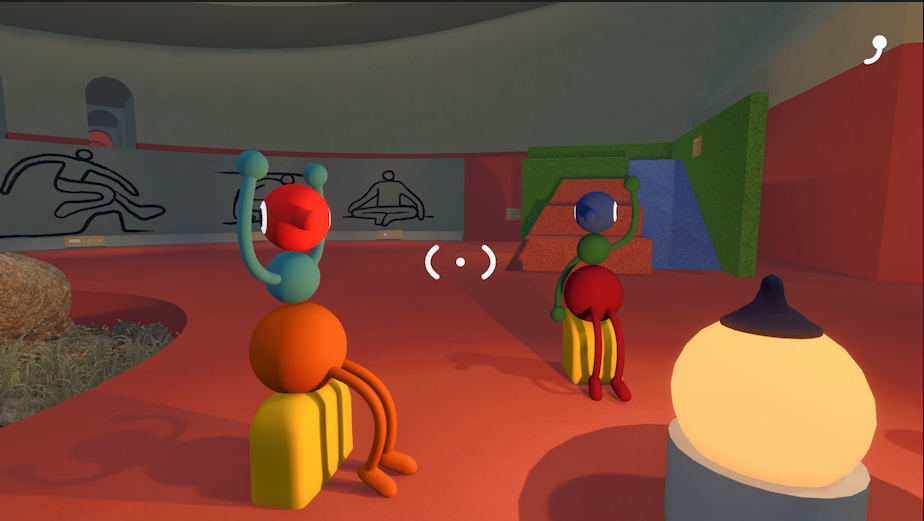
Every session starts at the hub... and with a cute hangout moment before going out to explore!
As we played, there were three organic phases that emerged, and three goals that I feel the devs accomplished in terms of what I've gotten from the experience thus far. Big Walk:
- encourages curiosity through exploration
- instills a sense of wonder in nature through slowing down
- facilitates joy and connection through collaborative puzzles
Encouraging Curiosity Through Exploration
After leaving the hub area, you'll see that the world opens up before you in a very Zelda "Breath of the Wild" manner. And that's really how it felt. The environments are hyper realistic — and very beautiful — filled with dense shrubs, babbling brooks, trees, and plenty of rocks. You'll also hear the sounds of nature as you move along. As you emerge, you'll quickly see a structure that'll catch your eye, and find that, naturally, your group will head towards it. We did, at least! And that pattern continues throughout the game. As you and your friends walk around, you'll see mysterious — and very colorful — playground-esque structures in the distance, and in the veins of many open world games, you'll find yourselves saying, "Why don't we try to get to that thing over there?" There's always something out of the corner of your eye, just one hill over, or down the way. And it invokes such a strong sense of "just a bit further" and "just one more stop" that the desire to explore is natural. And I don't know what it is about mountains and hills, but when in doubt, we found ourselves just going to the top of a hill to get our bearings (and often take time to enjoy the view).
You'll stumble across all manner of strange structures. Some are clearly puzzles, others hold unique tools that you can use — like walkie-takies or megaphones and flare guns. Tools also have no instructions, you can use as you find helpful (or not!) The compass? Totally useless to me: I go by landmarks. Flare guns became elaborate ways to point out what we were looking at (and light up the world when it got too dark).
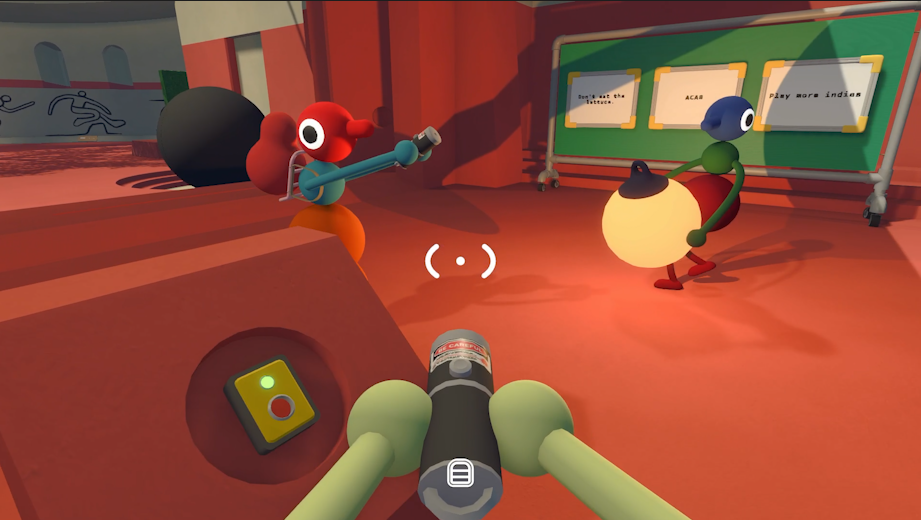
Lasers are fun. Try to resist the temptation to immediately shine them into your friends eyes (I couldn't!)
As you get familiar with the area, you'll find landmarks that help you orient yourself, and what was a strange unfamiliar world becomes increasingly comforting. It's like moving to a new neighborhood, and finally becoming a regulars. What was once an unfamiliar, sometimes slightly scary, island potentially filled with danger, turned into "our island". We came up with names for particular landmarks, like "The Chalice", "Cheese Wheel", and "Bougie House" that became a part of our group's lexicon and understanding. Becoming familiar with an environment in a game is something that happens any time you hop into a new world, but I loved that it was familiarity based on actual experiences with my friends. We were creating meaning, together! We have memories at every major landmark, and even some not major landmarks, and through that we were able to create meaningful connection to what felt vast and unfamiliar as well as to each other.
The proximity chat does require proximity: conversations don't necessarily carry, so to be able to speak to one another, especially without tools, you've got to be pretty close to each other. But that's part of the fun: you want to stick together to be able to point out different details, to share thoughts, or even make sure you can use certain tools together (like the map, which is actually quite hard to read on your own because of it's huge size). Exploration is designed to be a group activity, and you're encourage to stick together (although, I will say that getting slightly lost will happen, and it's always an adventure).
And please don't be tempted to try and use another program to help "make talking more efficient": it is a part of the design that communication sometimes is more restricted or challenging. In a game that's about walking and yes, talking, the ways that you can — and often can't — communicate is what makes some of the silliest and most memorable experiences happen.
There is a day and night cycle in the game that isn't tied to the real-world clock. It moves relatively quickly, and serves as a natural pacer for activities. When darkness falls, it gets DARK: the first session we played, it was even a bit unnerving as we were walking through unfamiliar areas, hearing the sounds of nature, unsure if anything bad could happen to us. Fortunately, a) nothing bad can happen to you other than potentially getting separated for a bit and b) there are tools and details — like your very bright eyes — that can help you stick close to one another and navigate even in the darkness. And, while we did sometimes foray out into the darkness, we often found ourselves using the evenings to relax, sit and chat, enjoy some music, and plan out what we hoped to do when the sun rose.
Instilling Wonder At The Natural World
Vista watching is interesting because it was one of those activities featured in the trailer that I felt was nice conceptually, but wondered how much — if at all — would we actually be compelled to enjoy nature when there were puzzles to solve and things to discover.
But wow. What a view it is when the sun rises. Or sun sets. Or just as you look around an admire the world around you with the sun up. Even after 10+ hours in the game, all of us continued to marvel at how beautiful this world is, and how natural it feels to stop every once in a while to appreciate it. And how this digital world felt so very…organic. It's a testament to the sound design, especially, as the sounds of bugs and other critters, as well as the ocean and stomping through the brush, really made this world come to life. I LOVE the soundtrack of the this game — the music is quirky and bizarre and beautiful — but we often found ourselves opting to turn off the radio and just appreciate being "outside". I think every session we've had, someone's looked up at the stars and wondered if those constellations are real, and we've marveled at the water as we've swam in it. It's a testament to the design of this game where we, as players, found it just as valuable to sit and just watch the world go by and not simply focus solely on getting to the next puzzle.
I find it beautiful that it feels like this is a digital space designed to help facilitate friendships and be present in this moment: between locations where you're actively solving puzzles and collaborating on a specific problem, but also in that there are other spaces that are built for more relaxing, communal moments, like a cliffside with some music and seats, or a beach lounge area.
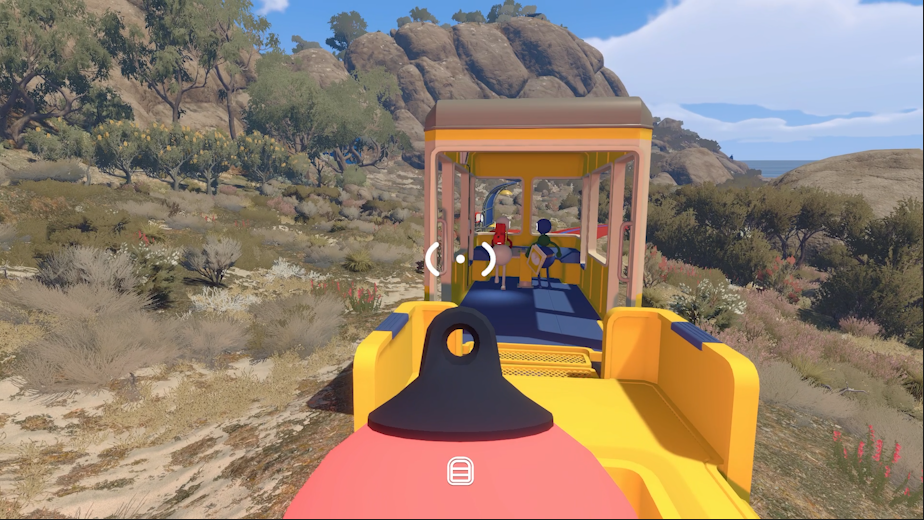
My favorite mode of transportation (aside from my own two feet, of course)
Facilitating Joy + Connection Through Collaborative Puzzles
Puzzles are scattered throughout the island, made distinct through their Fisher Price primary colors and playground style. Like your character model, these puzzle locations stand out from the world in a way that feels delightful and slightly surreal, again like preschool toys with their rounded corners, and simple shapes.
Within each puzzle, you receive a…well, something. We're not given a name for it. Because it looked a little like our own heads, we landed on "skulls," and I'm truly curious to see what other folks end up calling it as they play. As you gather these skulls, you'll put them into major landmarks scattered about the world to unlock different elements around the island. Some unlock access to other locations on the island, others unlock modes of transportation, and so on. Why are we unlocking these things? I honestly couldn't say at this point: there's a giant black orb at one side of the island that I'm assuming leads to the end of the game, but we haven't gotten there yet.
These puzzles range in what they ask of you as players. There are some obstacle courses and more straightforward physical challenges, but bulk of these puzzles involve finding ways to communicate and collaborate in situations where typical communication via proximity chat is limited. Think asynchronous escape room scenarios, where one or two people can see one part of the solution, but it needs to be completed by the others. Or silly games that you might play on the first day of school or theater camp to get to know other people. A big part of the fun is discovering the puzzles and trying to sort out what it wants from you and your crew, and so far in our time, we haven't seen exact repeats (although there are some themes that'll get riffed on and made a bit more challenging as you progress).
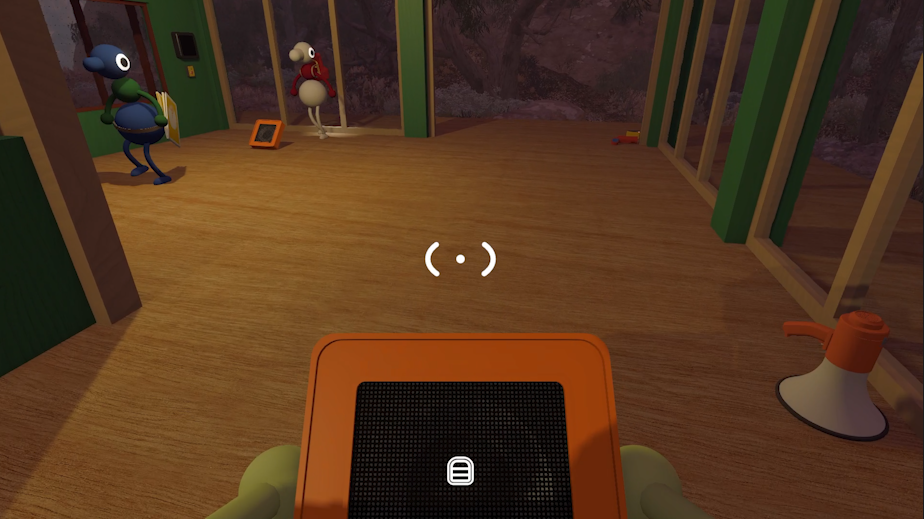
The joy, fun, and silliness comes from how you end up communicating with one another to get there, often trying to mime wildly with your characters, yelling at the screen knowing that the folks on the other side of the wall can't quite hear you or trying to convey a symbol by using your arms and body. I appreciated that these puzzles are created so that everyone in the group can involved in some way, utilizing different strengths and skills. With the three (or four) of us, each person always had something to do, and everyone was usually needed in some capacity: it felt nice that there really wasn't a scenario where one or two of us were doing all the heavy lifting, or where one of us was taken out and unable to enjoy the fun.
And, as cheesy as it sounds, I can't understate the delight we all felt every time we got a solution correct, confetti rained down on our group, and we were able to jump for joy and celebrate our victory.
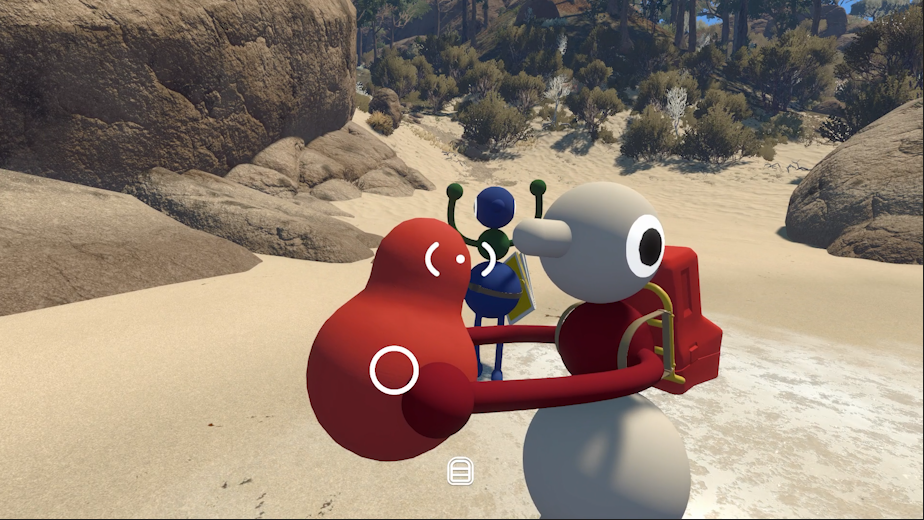
Skull? Gourd? Something else entirely? Regardless, we gotta collect 'em all!
The only point of potential friction that I'd want to highlight here is that with fewer players (for example, 2), your ability to carry a bunch of skulls is limited to your hands (which means you can carry two items total)…maybe a few more if you've unlocked additional ways to carry items, but those additional ways only add a slot or two. This means you may be making more trips back and forth to those major landmarks to drop them off. With bigger groups, I could see those landmarks unlocking a bit more quickly as you'd be able to gather more skulls from puzzles in a single excursion. This isn't a full critique, even, but something to highlight as a difference you may feel based on your group size.
Should You Play Big Walk?
All of this is to say: this is a game that made me actually feel like I was hanging out with my friends, perhaps as close to IRL hangouts as I've ever felt in a game. And, quite frankly, this was the most outside I've ever felt while being inside playing a game.
I think Big Walk is easy to recommend to people who already really enjoy co-op titles with proximity chat and generally being silly with friends. I also think this game is especially well suited for people who, like me, may not have normally be drawn to multiplayer games because it does have a more gentle pacing, offering a really nice ebb and flow between more action-filled moments and times to chill, and it really emphasizes on everyone being present in the moment and a part of the fun in whatever ways they're able.
This is also a multiplayer game that I can see people with a wide variety of gaming proficiencies play. I think if I had someone who was relatively new to gaming, and was okay with first person perspective…I could totally hand them the controller and in 15 minute or less, they would feel able comfy enough with the controls to participate. That kind of approachability in a game is INCREDIBLE!
Big Walk felt like distilled joy with how often we found ourselves laughing, celebrating, dancing, jumping for joy, and group-hugging. We all felt HAPPY playing this game and the time we spent together felt meaningful and memorable. I have our group chat to prove it: immediately after every session, all we wanted to do is figure out when we can play again.
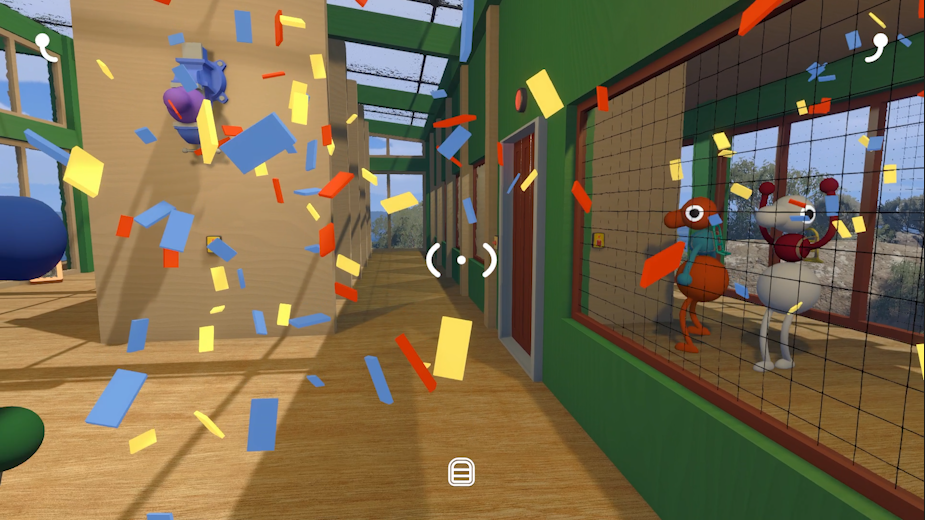
It's always a good time for confetti!
So, should you play Big Walk? Yes, I absolutely think this is something everyone should try. Because of it's focus on cooperation, it's a game where you can deepen your bonds with friends, and also really easily get to know people even better! I can't recommend it highly enough based on the time I've spent with it thus far.
Remaining Questions
Now, as I mentioned, I haven't actually finished this game yet. And, while I already feel like this game is incredible as is, there are a few questions I have as we head into our final sessions with the game.
There are mysteries we need to figure out: puzzles we haven't solved yet involving mysterious orbs, random buttons, and structures that seem like they should have a purpose but aren't connected to anything we've activated…yet.
Barring something totally out of left field, I really only see any additional potential lore and mysteries we get by the end as elevating my opinion of this game. If there was nothing and the game were to end at the point I've played? Honestly? That's fine. The game is solid even without a story or some overarching mystery. But…I am curious, and I'll definitely keep you all posted as we finish the game.
Final Thoughts (For Now)
I remember reading somewhere a long time ago that food can feel like it tastes better when shared. Now, I don't know if that's 100% true, but I do know that when I have a good meal, my enjoyment IS deepened when I have someone to enjoy it with me. Sharing food helps you feel more connected to that person, helps strengthen community, boosts your mood, and — if they're sharing with you — could potentially get you to try something you've never had before.
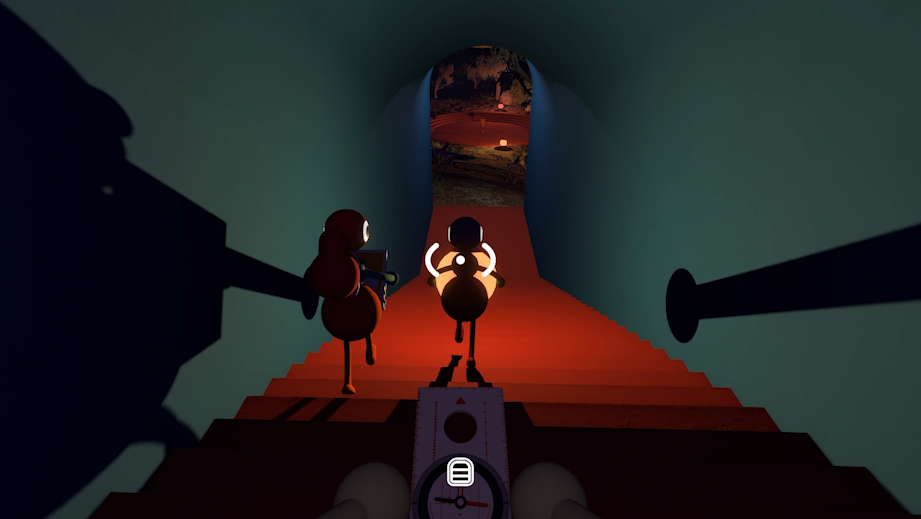
Big Walk really is about the friends -- and memories -- we make on the way.
And when I play Big Walk, it evoked a similar feeling. Big Walk has impeccably designed puzzles and a beautiful world that's made more meaningful because you share it with others. It allows you to feel more connected to those people, to create a sense of community through silliness and curiosity, and maybe gets you to try new ways of playing and thinking as you move through the island together.
As I mentioned at the start: Big Walk is not procedurally generated. It's not meant to last forever. I will admit, that is the bittersweet component to this game's design -- it does have an ending. It's meant to be finished. And, as of right now, there aren't any plans for DLC or additional content, which I respect, but also: it would be a GIFT to be be able to stay in this world longer.
But, what I feel excited about is to join in on other friends' Big Walk journeys and be there for THEIR moments of discovery and awe. I think, in it's own way, that's part of the intentionality of this game. That we're meant to have an experience, and — if we find we loved it — we'll discover a different kind of joy in bringing other people into the fold and expanding our own community and memories in this world.
Big Walk is a communal experience with big heart, and I am honestly just so happy that even more people are going to enjoy it now that it's fully released. Congratulations, House House, you've made something truly special, and I REALLY hope you've got some confetti cannons to celebrate!